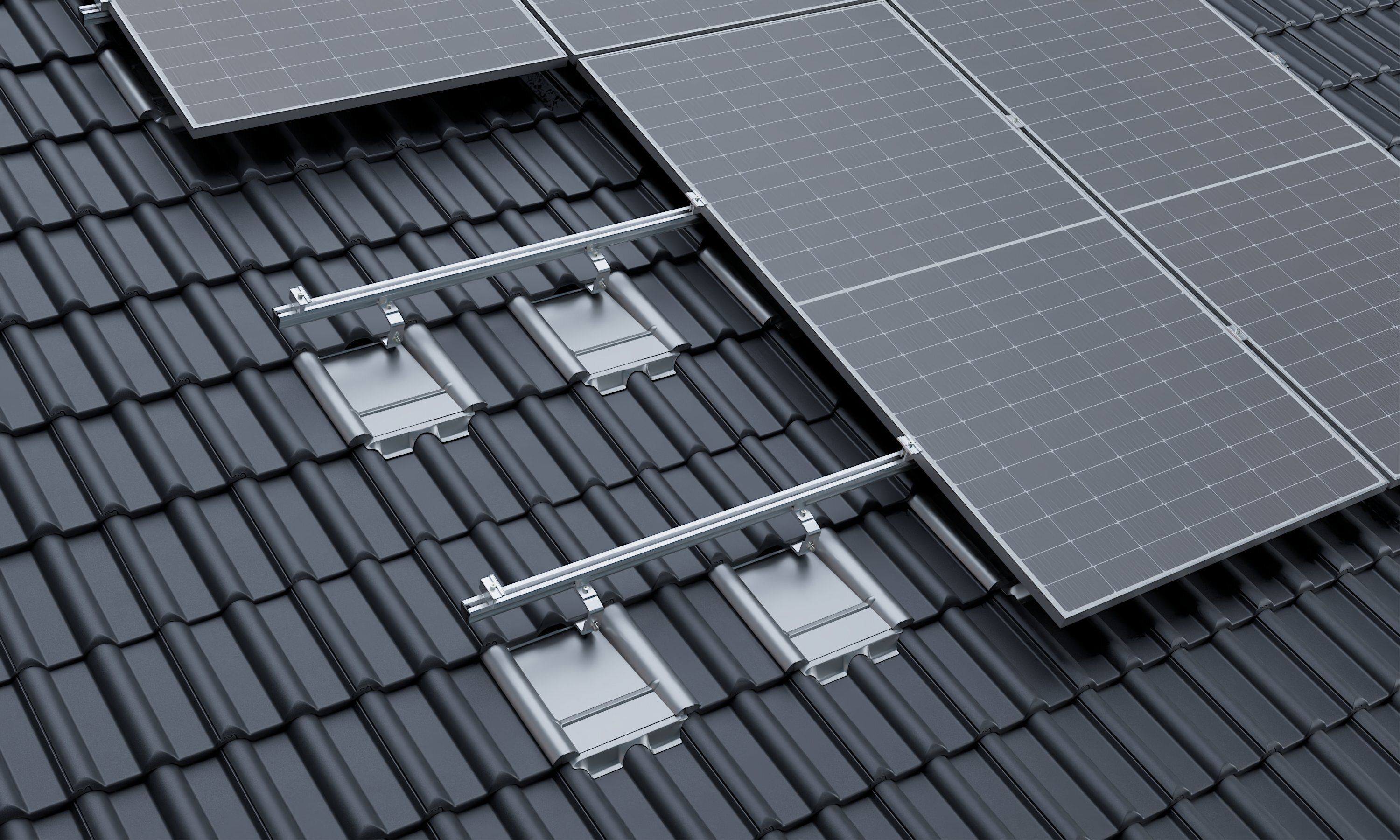
The PV substructure for a pitched roof depends first and foremost on the roofing material: tiles, plain tiles, corrugated fiber cement, or trapezoidal sheet metal determine which roof mounting option is suitable. Next, rafter spacing, roof batten height, module size, and wind and snow loads determine the specific variant. This guide walks you through three steps from roof type tothe appropriateCOMPACTPITCH variant and shows you which measurements to take on the roof.
Regardless of the roofing material, every substructure serves the same purpose: it transfers the system’s dead weight, as well as wind and snow loads, through the designated mounting points to the roof’s load-bearing layer. At the same time, the water-bearing layer must remain watertight. On a tile roof, the roof hook sits beneath the tile and must pass through the roofing material; on a corrugated metal roof, the hanger bolt passes through the roof sheathing. This is precisely where the systems differ.
Do you already know the roof type, module layout, and location? Then design the project directly inAEROTOOL; it supports the planning process with a project report and a materials list. For pitched roofs in Germany and Austria, there’s also AERO.GO, which generates structural calculations, an installation plan, and a materials list based on just a few roof specifications. The AERO.GO guide shows you how a project works there.
Which mounting system is suitable for which roof covering? An overview of the COMPACTPITCH systems
The selection process consists of two steps. First, the roofing material is determined: tiles, flat roof tiles, corrugated fiber cement, corrugated sheet metal, or a profiled metal roof. Next, the appropriate roof attachment is selected. The table provides an initial guide; the specific variant also depends on the roof structure and project requirements.
Planning reliability included: Roof hooks , rails, and clamps are designed to work together within theCOMPACTPITCH modular system. The specific design is determined on a project-by-project basis usingAEROTOOL; technical specifications and documentation are available for each system.
Tile Roof: Which Roof Hook Matches the Tile Shape, Roof Battens, and Rafters
For tile roofs, we offer fiveCOMPACTPITCH systems with different focuses. Three characteristics of your roof determine which one to use: the tile shape, the height of the roof sheathing, and the orientation of the rafters. If your roof has plain tiles, the XM-PL is designed for that. For low roof sheathing—such as under “monk-and-nun” or “Portuguese” tiles—the XT35-VLOW is a good choice; for uneven or warped rafters , the XT-R 2.0 is recommended. If none of these specific conditions apply, XM-F REPTILE is the universal choice: The adjustable cover plate decouples the hook’s position from the tile grid, allowing the hook to sit directly above the rafter. For high snow loads, XM-B replaces the tile beneath the hook with a metal replacement tile.
COMPACTPITCH XT-R 2.0: Roof hooks for uneven roof surfaces
COMPACTPITCH XT-R 2.0 is designed for roofs that do not exactly match the blueprint. The foldable roof hook can be adjusted in five degrees of freedom; the rail clamp compensates for unevenness and deviations in the rafters. One fixation per rail is sufficient; the remaining hooks remain floating, which saves installation time. The foldable design keeps the packed size small; installation requires only one tool, and a single person can perform the adjustment.
All roof hooks for tile roofs with technical specifications:COMPACTPITCH XT-R 2.0 in detail > Roof Hook Overview
Prevent broken tiles and leaky penetrations: COMPACTPITCH XM-B, XM-F, and XM-PL
The XM series addresses the point where the roof hook penetrates the water-bearing layer. Instead of modifying the existing tile, the hook is integrated into the roof surface—depending on the system—using either a metal replacement tile or a flexible cover plate.
Two principles, two applications: The metal replacement tile replaces the roof tile at the hook’s location. The flexible cover plate can be adapted to the contour of existing tiles and allows the roof hook to be positioned above the rafter. The appropriate solution depends on the tile shape, roof structure, and the planned connection.
The three systems in detail:
- COMPACTPITCH XM-B replaces the roof tile beneath the roof hook with a metal replacement tile made of galvanized steel with a zinc-magnesium coating. This reduces the risk of breakage, especially under snow loads. Self-adhesive PU soft foam seals the transition beneath the hook against driving rain and drifting snow; no cutting of the tile is required.
- COMPACTPITCH XM-F REPTILE connects the roof hook to an aluminum cover plate that adapts to the contours of different roof tiles. This ensures the hook sits centered on the rafter regardless of the tile layout and transfers loads directly into the supporting structure. In areas with lower snow loads, combining it with the X60 rail can reduce the number of roof hooks; the structural analysis determines how many hooks your project requires. Installation can save up to 40 percent of the time.
- COMPACTPITCH XM-PL is designed for plain-tile roofs. Otherwise, small-sized interlocking roof tiles would require time-consuming adjustments to fit the hooks; instead, the system combines the stainless-steel roof hook with a sheet metal replacement tile that substitutes for the interlocking tile in the installation area. This reduces the number of preparatory steps during installation. The replacement tiles are available in red and black.
Specifications and data sheets for the XM series: XM-F REPTILE · XM-B · XM-PL
Low-pitch roof battens, interlocking or Portuguese-style tiles? COMPACTPITCH XT35-VLOW
COMPACTPITCH XT35-VLOW is designed for roofing with low roof battens, such as monk-and-nun or Portuguese tiles. The aluminum roof hook is compatible with all X-rails and components ofthe COMPACTPITCH modular system. Depending on the version, attachment is achieved using a hammer-head screw or a quick-mount adapter; installation on concrete substrates is also supported.
Assembly instructions, accessories, and data sheet: COMPACTPITCH XT35-VLOW
Corrugated sheet metal, corrugated fiber cement, and profiled sheet metal: Mounting system with hanger bolts (COMPACTPITCH XW and XWS)
COMPACTPITCH XW is available as a hanger bolt system for corrugated sheet metal, trapezoidal sheet metal, sandwich panels, and corrugated fiber cement. The long thread allows the rail to be adjusted vertically; the specific fastening method depends on the substructure, profile, and structural design.
COMPACTPITCH XW is the cost-optimized solution for locations with little snow. For regions with heavy snowfall, theCOMPACTPITCH XWS hanger bolt set is available. Both variants can be combined with rails to create the structural spacing between the module and the roof sheathing.
For metal profiled roofs, the specializedCOMPACTMETALproduct family is suitable depending on the profile: TM for standing seam and click profiles, TS and TL for trapezoidal profiles, and TR for sandwich panels. The profile determines whether the modules are clamped or screwed in place. The Metal Roof Guide explains which system is suitable for which sheet metal and why.
Hanger bolt sets, variants, and technical documentation: COMPACTPITCH XW and XWS
Ventilation in pitched roofs: How the air gap between the module and the roof sheathing works
Crystalline solar modules lose power as cell temperature rises. The air gap between the module and the roof sheathing promotes air exchange and helps dissipate heat. The size of this gap in a given project depends on the roof structure, system geometry, and the selected combination. For the XT35-VLOW and XW models, rear ventilation of the modules is a standard product feature; with the XW, we combine it with higher energy yield.
For system selection, this means: rooftop mounting on rails raises the modules above the roof covering. The height of the roof hooks, the height of the rails, and the choice of clamps collectively determine the distance from the roof deck. The specific installation height is taken into account during project design.
Three steps to finding the right PV mounting system for your pitched roof
- Determine the roofing material. Tiles or roof tiles call for the roof hook series; plain roof tiles call for XM-PL. For corrugated sheet metal, corrugated fiber cement, or profiled sheet metal, hanger bolts orCOMPACTMETAL solutions are suitable. The exact selection depends on the roofing material and the specific profile.
- Survey the roof on-site. The information you need is listed below. For tile roofs, the roof sheathing and rafter orientation determine the appropriate variant, as described in the section on tile roofs.
- Design the project. Enter the location, roof geometry, roofing material, and module type intoAEROTOOL. The software supports the design process with wind and snow load data, a project report, and a materials list.
Record the following information during the site visit:
- For tile roofs: tile manufacturer and model (for verification against the compatibility list in the download section of XM-F and XM-B), height of the roof battens, rafter spacing, and whether the rafters are straight
- For corrugated metal, corrugated fiber cement, and profiled sheet metal: profile or sheet type and the substructure into which the hanger bolt is driven
- For every roof: location, roof shape, roof pitch, presence of obstructions, and module type
Design the project now in AEROTOOL → Project report and material list for further planning
Pitched roof in Germany or Austria? Alternatively, start the project in AERO.GO and get structural analysis, an installation plan, and a materials list based on just a few roof specifications.
Still unsure about which system to choose? An overview of all COMPACTPITCH systems for pitched roofs
Frequently Asked Questions About PV Mounting Systems on Pitched Roofs
Which mounting system is suitable for a tile roof?
For concrete and clay tiles,COMPACTPITCH XM-F REPTILEis the universal choice: The adjustable cover plate decouples the hook’s position from the tile grid, so the hook sits directly above the rafter. For warped rafters, consider the XT-R 2.0; for flat roof sheathing, the XT35-VLOW; and for plain-tail tiles, the XM-PL. In areas with high snow loads, the XM-B replaces the tile beneath the hook with a metal replacement tile.
Which system is suitable for trapezoidal, corrugated metal, or slate roofs?
For corrugated sheet metal, trapezoidal sheet metal, sandwich panels, and corrugated fiber cement,COMPACTPITCH XWwith a hanger bolt is suitable; in regions with heavy snowfall, the XWS variant is recommended. For standing seam, click-lock profiles, trapezoidal profiles, and sandwich panels,COMPACTMETAL is available. For slate roofs, there is no general recommendation: it depends on the roof structure and structural requirements and is determined during the design phase.
How can broken tiles and leaks be prevented during installation?
By ensuring that no tile needs to be cut at the hook position.COMPACTPITCH XM-B replaces the interlocking tile beneath the hook with a metal replacement tile; a self-adhesive PU soft foam seals the area against driving rain and drifting snow. XM-F REPTILE uses an adjustable cover plate, while XM-PL combines the roof hook for plain-tail roofs with a sheet metal replacement tile.
Which roof hook is suitable for low roof battens, monk-and-nun tiles, or Portuguese tiles?
COMPACTPITCH XT35-VLOW is designed for low roof battens as well as monk-and-nun and Portuguese-style tiles. The aluminum roof hook is compatible with X-rails andCOMPACTPITCH components. Depending on the model, various fastening and positioning options are available, including for concrete substrates.
How much clearance is needed for rear ventilation on a pitched roof?
There is no single fixed value that applies to all roofs: The required clearance depends on the roof structure and system combination. On-roof mounting on rails creates an air gap between the module and the roof sheathing, which facilitates air exchange. Roof hooks, rails, and clamps determine the specific installation height; this is verified during the design phase.
What information do I need about the roof before choosing a mounting system?
For tile roofs, you’ll need the tile shape and manufacturer, the height of the roof sheathing, the rafter spacing, and whether the rafters are straight. For corrugated metal, corrugated fiber cement, or profiled sheet metal, you’ll also need the profile or sheet type and the substructure beneath the roof sheathing. For every roof, you’ll need the location, roof shape, roof pitch, any obstructions on the roof surface, and the module type. Use this information to design the project in AEROTOOL.
When should I design a pitched roof with AEROTOOL, and when with AERO.GO?
Both tools are from AEROCOMPACT.AEROTOOL covers flat roofs, pitched roofs, facades, and open spaces, and provides 3D system design, a CAD plan, a project report, and a materials list. AERO.GO is the app for pitched roofs in Germany and Austria: With just a few roof specifications, it generates structural analysis, an installation plan, and a materials list.